Santa Rally Odds 🎅
Historical S&P 500 Data (1950-2024)
79%
Win Rate+1.3%
Avg ReturnDon’t miss the move. Spot it first.
TRACK CHARTS ON TRADINGVIEW ↗Get the Holiday Trading Calendar sent to your email: 👇
Every December, Wall Street traders prepare for a phenomenon known as the Santa Rally (or Santa Claus Rally). It is one of the most statistically reliable seasonal trends in finance, yet many retail investors miss the specific timing required to profit from it.
Contrary to popular belief, the Santa Rally does not last all month. It is a very specific 7-day trading window where the S&P 500 has risen 79% of the time since 1950.
What Exactly is the Santa Rally?
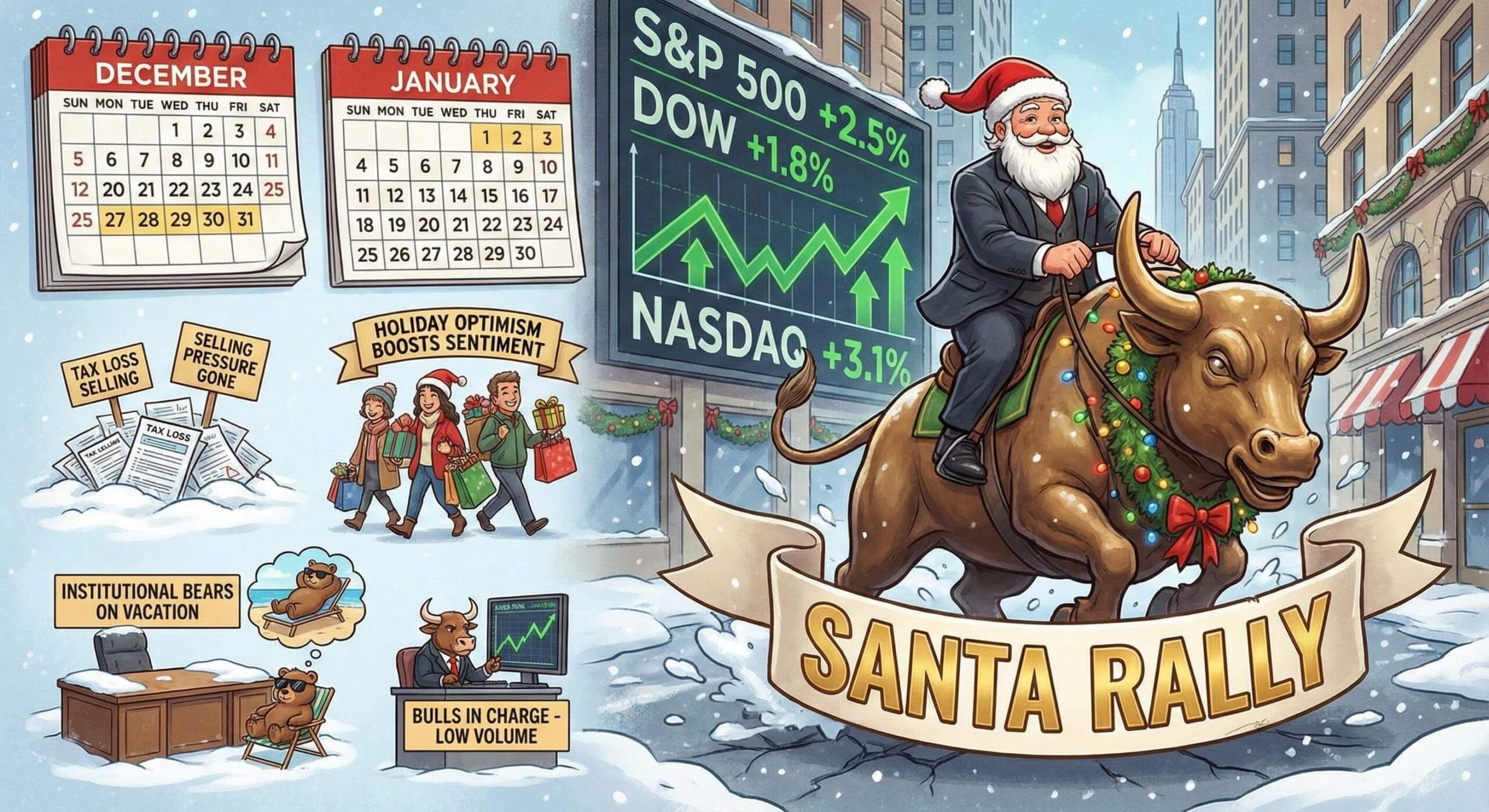
The term was coined by Yale Hirsch in 1972. It technically refers to the stock market’s performance during the last five trading days of December and the first two trading days of January.
Why does it happen? There are several theories:
- Tax Loss Harvesting Ends: Selling pressure from people claiming tax losses usually dries up by mid-December.
- Holiday Optimism: Retail spending boosts sentiment.
- Institutional Vacation: The “bears” (pessimists) tend to go on vacation, leaving the “bulls” in charge of a low-volume market.
The Statistics (1950 – Present)
Data doesn’t lie. According to Investopedia, the S&P 500 has averaged a 1.3% gain during this short 7-day window.
While 1.3% might sound small, that is the average annual return of a savings account—achieved in just one week. However, traders must be careful. If the rally fails to materialize, it is often seen as a bearish omen for the year ahead.
“If Santa Claus should fail to call, bears may come to Broad and Wall.”
The Psychology Behind the Pump
Markets are driven by humans (and algorithms programmed by humans). The Santa Rally is largely a self-fulfilling prophecy. Because traders know the stats favor a move up, they buy in anticipation of the move. This collective buying pressure forces the price up, confirming the bias.
Furthermore, “Window Dressing” plays a role. Portfolio managers want their end-of-year reports to look good, so they snap up high-performing tech stocks like Nvidia or Apple to show clients they own the winners. This creates artificial demand right before the books close.
Macro Risks: The Grinch Effect
The Santa Rally is not 100% guaranteed. In years where we have significant macro-economic headwinds—such as a Yield Curve Inversion or aggressive Federal Reserve rate hikes—the rally can be cancelled.
For example, in 2000 and 2008, the rally failed spectacularly as the broader economy entered a recession. Always check the broader trend before blindly buying.
How to Trade the Holiday Season
If you plan to trade this seasonal anomaly, precision is key.
- Identify the Dates: Mark the last 5 trading days of the year on your calendar.
- Wait for Confirmation: Don’t buy blindly. Use a charting tool like TradingView to ensure the trend is actually moving up on the 1-hour timeframe.
- Set Tight Stops: Volume is thin during the holidays. This means volatility can spike unexpectedly. Use our Position Size Calculator to manage your risk.
FAQ: Frequently Asked Questions
Does this apply to Crypto?
Crypto markets often correlate with the stock market during the holidays, but Bitcoin trades 24/7, so the specific “5-day trading window” is less precise than in traditional equity markets.
What happens if the rally fails?
If stocks drop during these 7 days, history suggests a difficult year ahead. It indicates that institutions are selling into the New Year rather than buying.
Conclusion
The Santa Rally is a powerful statistical edge, but it is not a magic money printer. Combine this seasonal data with proper technical analysis to give yourself the best probability of a profitable start to the New Year. Remember, the trend is your friend, but risk management is your survival kit.
Disclaimer: Seasonal trends are historical observations, not financial advice. Trading involves risk.